

Artificial Intelligence is not a novelty or future promise—it is here, accessible, and fundamental to business momentum. If you are not leveraging AI, you are accepting wasted effort and missed opportunity.
Traditional growth strategies—add more sales reps, chase more leads, close more deals—are costly and inefficient. AI rewrites this equation. It scales revenue and execution without tying success to headcount.
Below, we cut through the noise and detail how AI transforms revenue, sales, and strategic planning—with data and real outcomes, not empty claims.
Revenue growth: Predict, don’t guess
Revenue forecasting used to mean projecting last year’s numbers forward and hoping for growth. That is not a strategy. AI eliminates guesswork. By digesting vast amounts of data on customer behavior and market shifts, AI reveals what is truly driving revenue.
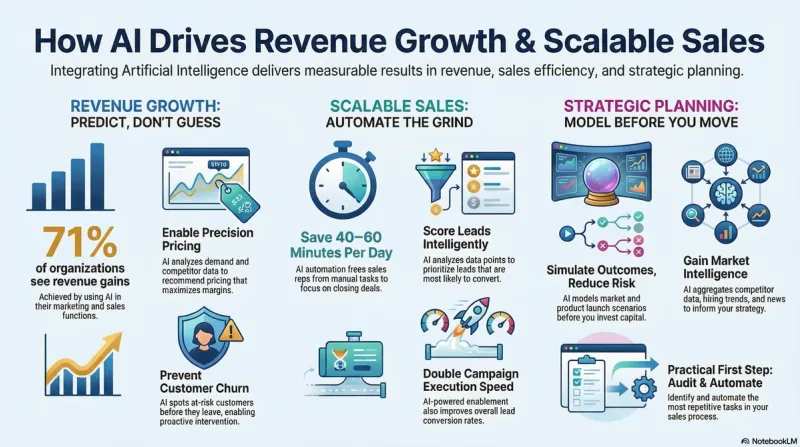
- 71% of organizations using AI in marketing and sales see revenue gains1
- AI leaders achieve 1.7x revenue growth and 3.6x higher shareholder returns over three years
Precision pricing
Dynamic pricing, powered by AI models, analyzes competitive and demand data to recommend pricing that maximizes margin. This is now common for SaaS vendors and B2B service firms, not just airlines.
Churn prevention
Keeping a customer is five times cheaper than finding a new one. AI spots patterns in usage and engagement that signal customer risk long before churn happens. Your team can intervene with precision and measurable impact.
Companies like Intercom have deployed AI agents that resolve customer queries from end to end, cutting support costs and boosting retention.
Scalable sales: Automate the grind
Every minute salespeople spend on manual tasks and unproductive outreach drains resources. AI does not replace your best reps; it automates repetitive work and highlights high-potential opportunities.
- 78% of companies use AI in at least one business function, led by sales and marketing
- AI-powered enablement can double campaign execution speed and improve lead conversions
Intelligent lead scoring
AI analyzes dozens of data points—site visits, email opens, past engagement—to prioritize leads most likely to convert. Human instinct can only go so far; AI brings objectivity to deal flow.
Targeted outreach
AI monitors external signals, like company funding or executive hires, and recommends timely, relevant, and personalized outreach. Result: less cold-calling, more qualified conversations.
Rep productivity
Enterprise users report saving 40–60 minutes per day through AI automation. Those hours go back to building relationships and closing deals.
Strategic planning: Model before you move
Old-school strategy often defaults to the loudest opinion, leading to costly missteps. AI-equipped leaders now run models to simulate markets, product launches, and pricing scenarios before investing.
- Firms using AI for strategy report not only higher revenue, but better customer satisfaction and competitive edge
Leaders use AI to optimize forecasts for inventory, supply chains, and other critical functions. Retailers like Lowe's have doubled online conversion rates when deploying AI assistants.
Market intelligence
Competitors leave digital evidence everywhere. AI tools aggregate news, hiring trends, and sentiment so you can react before the market shifts.
The path forward: Start with what drags you down
You do not need a massive transformation budget to start. Focus on the bottlenecks where people add little value compared to what automation could do.
A practical next step:
- Audit your sales process and automate repetitive tasks.
- Unlock siloed data to inform decisions on pricing, retention, and sales.
- Anchor planning to evidence and simulation, not tradition or intuition.
Research is clear: The winners over the next five years will not simply have the most powerful AI—they will be relentless about eliminating wasted effort so teams can focus on outcomes.
Do not wait for a consultant’s thick report. The tools are ready. Use them to drive real results.