Manual data entry errors cost organizations $12.9 million annually on average, while knowledge workers waste 58% of their workday on low-value coordination tasks rather than strategic work. For European mid-market companies, these hidden inefficiencies represent a significant competitive disadvantage—one that automation can address with documented ROI of 262-330% over three years. This report compiles primary-source statistics from McKinsey, Gartner, Forrester, academic research, and real company case studies to quantify exactly what manual processes cost your organization.
Manual data entry carries measurable error rates and substantial financial impact
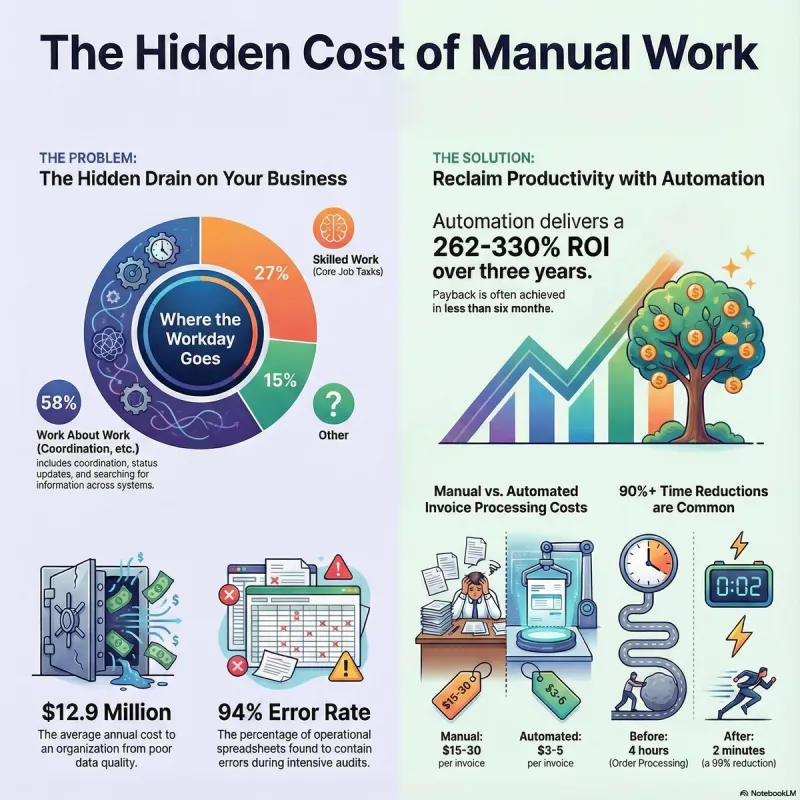
The foundational research on data entry accuracy comes from Raymond R. Panko at the University of Hawaii, whose work spanning 1998-2016 established that humans achieve only 95-99% accuracy when entering data—a figure that sounds acceptable until applied at scale. Panko's analysis of 14 laboratory studies involving 967 individuals found an average cell error rate of 3.9%, while field audits of operational spreadsheets discovered errors in 94% of spreadsheets examined through intensive inspection.
Medical research validates these ranges in high-stakes environments. A 2019 study in the Journal of the American Medical Informatics Association compiled error rates from multiple clinical settings: McSwiney and Woodrow found 1.14% clerical error rates, while Hong et al. documented 2.8% overall error rates ranging from 0.5% to 6.4% depending on the data field. The accepted industry benchmark of 1% error rate appears optimistic—empirical studies consistently find rates between 0.55% and 5%, with extremes reaching 26.9% in poorly controlled environments.
The financial consequences compound rapidly. Gartner's 2020 research established that poor data quality costs organizations at least $12.9 million per year on average, while 36% of participants in their primary research study estimated losing more than $1 million annually specifically due to data quality issues. Thomas Redman, writing in Harvard Business Review (September 2016), calculated that poor data costs the U.S. economy $3.1 trillion per year—approximately 18% of GDP at the time.
The 1-10-100 rule, established by Labovitz and Chang in 1992, quantifies the escalation: $1 to verify data at the point of entry, $10 to correct errors after the fact, and $100 in failure costs per record annually if errors go unaddressed. Industry analysis from Conexiom estimates the average cost per data entry error at $50-150, depending on how far it propagates through systems before detection.
Knowledge workers spend the majority of their time on work about work
The Asana Anatomy of Work Global Index 2023—a survey of 9,615 knowledge workers across six countries—delivers perhaps the most striking finding: workers spend only 27% of their time on the tasks they were hired to do. The remaining time breaks down into "work about work" (coordination, status updates, searching for information) consuming 58% of the workday, with 62% of the day lost specifically to mundane, recurring tasks.
The waste compounds dramatically when annualized. According to Asana's calculations, the average knowledge worker loses 103 hours per year to unnecessary meetings, 209 hours to duplicative work, and 352 hours to talking about work rather than doing it. APQC research (November 2021, surveying 982 knowledge workers) found that only 30 productive hours emerge from a 40-hour workweek, with 8.2 hours weekly—20% of work time—spent looking for, recreating, and duplicating information.
Forrester's research for Airtable established that knowledge workers spend 30% of their time simply looking for data, while large organizations maintain an average of 367 different software applications and systems that don't communicate effectively. A separate Forrester analysis found knowledge workers spend 12 hours per week "chasing data" across disconnected systems.
For HR teams specifically, People XCD research found that organizations using manual data entry spend 15-50% of HR team time managing information by hand. Unit4's Global Productivity Study calculated that office workers lose 552 hours per year (69 working days) to administrative or repetitive tasks. Sales representatives, according to industry analysis, waste more than 27% of their time due to incorrect data alone—wrong phone numbers, outdated contact information, duplicated records.
Consulting firm research establishes automation ROI between 30% and 330%
McKinsey Global Institute's foundational 2017 report "A Future That Works" analyzed 2,000 distinct work activities across 800+ occupations and concluded that 50% of work activities globally could be automated using then-current technologies—representing $15 trillion in wages worldwide. Their June 2023 report on generative AI revised these estimates dramatically upward: gen AI and other technologies could now automate 60-70% of employees' time, potentially adding $2.6-4.4 trillion annually across 63 use cases analyzed.
The most recent McKinsey research (November 2025, "Agents, Robots, and Us") examined skill requirements across 800 occupations and 2,000+ activities, finding that currently demonstrated technologies could automate 57% of U.S. work hours, unlocking $2.9 trillion in economic value by 2030. Importantly, more than 70% of today's skills remain applicable to both automatable and non-automatable work—automation augments rather than replaces.
Forrester's Total Economic Impact studies provide concrete ROI figures from vendor implementations. Their 2024 TEI study for SS&C Blue Prism documented 330% three-year ROI with payback in less than six months for the composite organization analyzed. The Forrester TEI study for UiPath found 97% ROI, while the study for Automation Anywhere demonstrated 262% ROI over three years, with $1.1 million in benefits from error reduction alone and $2.7 million in compliance and audit savings.
Deloitte's seventh annual intelligent automation survey (June 2022, surveying 479 executives across 35 countries) found 74% of organizations already implementing RPA, with actual cost reductions achieved by implementers averaging 32%—up from 24% in 2020. One financial services executive reported cost reductions exceeding 70% in targeted process areas. The average payback period has extended slightly to 22 months (from 16 months in 2020), reflecting more ambitious enterprise-scale implementations.
Gartner's market forecasts project the hyperautomation-enabling software market reaching $1.07 trillion by 2028 at a 13.9% CAGR. Their 2021 prediction that organizations would lower operational costs by 30% by 2024 through hyperautomation appears on track. The RPA market specifically grew 22.1% in 2023 to reach $3.2 billion, outpacing both the AI market (13.2% growth) and global software revenue (11.1%).
The 88% AI failure statistic requires important context
The widely cited claim that "88% of AI projects fail" originates from IDC research in partnership with Lenovo, published in the "CIO Playbook 2025" (March 2025). The finding specifically states: "88% of observed POCs don't make the cut to widescale deployment. For every 33 AI POCs a company launched, only four graduated to production."
This measures proof-of-concept conversion rates, not overall AI project failure. The distinction matters: POCs are designed as experiments, and high attrition rates are expected. The IDC report attributes this to organizational readiness gaps: "The high number of AI POCs but low conversion to production indicates the low level of organizational readiness in terms of data, processes and IT infrastructure."
Multiple sources cite similar figures with different methodologies:
- RAND Corporation (August 2024, based on interviews with 65 data scientists): "More than 80% of AI projects fail—twice the rate of failure for information technology projects that do not involve AI"
- MIT Media Lab's Project NANDA (July 2025, analyzing 300+ publicly disclosed AI initiatives): "95% of AI pilot projects failed to deliver any discernible financial savings or uplift in profits"
- Gartner (February 2018 prediction): "Through 2022, 85% of AI projects will deliver erroneous outcomes due to bias in data, algorithms or the teams responsible"
The RAND research identified five root causes: stakeholders misunderstanding the problem (most common), organizations lacking necessary training data, focusing on technology over problems, inadequate data infrastructure, and applying AI to problems too difficult for current capabilities.
Important caveat on MIT NANDA research: The 95% figure has drawn methodological criticism. Futuriom noted that the report's data presentation is unclear in places, and the sample size (52 organizational interviews, 153 survey responses, 300+ initiative reviews) may not support such a sweeping conclusion. The research also comes from Project NANDA, which develops infrastructure for decentralized AI agents—creating potential incentive to suggest current approaches aren't working. The finding is better interpreted as "95% of pilots showed no measurable P&L impact yet" rather than "95% of AI projects failed."
That said, MIT NANDA found that companies purchasing AI tools from specialized vendors succeed 67% of the time, while internal builds succeed only 33% of the time. Mid-market companies also transition pilots to production faster—approximately 90 days versus 9+ months for enterprises.
Hidden costs accumulate through data silos, turnover, and compliance risks
Data silos cost organizations 20-30% of annual revenue according to IDC Market Research, while Forrester's Data Culture and Literacy Survey (2023) found that more than 25% of global data and analytics employees estimate they lose more than $5 million annually due to poor data quality, with 7% reporting losses exceeding $25 million. The DATAVERSITY 2024 survey found 68% of organizations cite data silos as their top data management concern—up 7 percentage points from the previous year.
Employee turnover linked to disengagement costs organizations significantly. Gallup's State of the Global Workplace Report 2023 calculated that low employee engagement costs the global economy approximately $8.9 trillion annually—equivalent to 9% of global GDP. Organizations with high engagement experience 59% less turnover than those with low engagement. The Society for Human Resource Management estimates replacement costs at 50-200% of annual salary, with 60-70% of turnover costs being hidden (lost productivity, morale, institutional knowledge).
The Gallup report found that 33% of employees cite boredom and needing "a new challenge" as reasons for leaving. U.S. employee engagement fell to 31% in 2024—down from 36% in 2020 and the lowest in a decade—suggesting automation of mundane tasks has strategic retention implications.
Compliance risks from manual processes generate substantial penalties. DLA Piper's GDPR Fines Tracker (January 2025) documented €5.88 billion in cumulative GDPR fines since May 2018, with €1.2 billion issued in 2024 alone. The largest single fine—€1.2 billion against Meta in May 2023—resulted from inadequate data transfer protections. Gartner research found that manual Data Subject Access Request (DSAR) processing costs approximately $1,400-1,500 per request, making automation essential for organizations receiving high request volumes.
IBM's Cost of a Data Breach Report 2024 established the global average breach cost at $4.88 million—a 10% year-over-year increase and the largest jump since the pandemic. Organizations with AI and automation in security operations reduced breach costs by an average of $2.2 million, while those with incident response teams saved 58% on breach costs.
European and Swiss markets show distinct adoption patterns
Eurostat's 2025 survey found 20% of EU enterprises with 10+ employees now use AI technologies—up from 13.5% in 2024 and 8.1% in 2023. Adoption varies dramatically by company size: 41.2% of large enterprises (250+ employees) versus 20.9% of medium-sized and just 11.2% of small enterprises (10-49 employees). Denmark leads at 42% adoption, while Romania (5.2%) and Poland (8.4%) lag significantly.
Switzerland outperforms the European average. The Microsoft Work Trend Index 2024 found 82% of Swiss knowledge workers use generative AI at work—surpassing the 75% global average. The Michael Page Talent Trends 2024 study documented 32% of Swiss employees using AI in their roles versus 23% European average—making Switzerland the European leader.
However, ETH Zurich research with Swissmem (March 2024, surveying 209 senior managers in Swiss tech) revealed implementation challenges: only 25% of companies have an AI strategy, 68% lack sufficient in-house AI talent, and 56% report insufficient access to AI training. The AXA/Sotomo Swiss SME Study 2024 found 55% of Swiss SMEs have integrated AI into workflows, up dramatically from prior years—but 45% still rate AI as positive rather than essential.
The European Investment Bank documented a persistent digitalization gap: 37% of EU firms had not adopted any advanced digital technology by 2020 versus 27% in the U.S. In manufacturing specifically, 66% of EU firms adopted at least one digital technology versus 78% in the U.S. The construction sector gap is wider still: 40% EU versus 61% U.S..
German SMEs invested €31.9 billion in digitalization projects according to KfW Research (2024), while 62% of German companies now use Industrie 4.0-related technologies per Germany Trade & Invest data. However, infrastructure gaps persist: only 29.8% of German homes have fiber-optic internet versus the 64% EU average.
Spreadsheet errors affect virtually all complex business models
Professor Raymond Panko's research at the University of Hawaii represents the definitive academic work on spreadsheet errors. His compilation of seven field audits found errors in 24% of 367 spreadsheets examined—but this understates the problem, as early audits used weak methodologies. More recent intensive inspections found errors in at least 86% of spreadsheets audited, while 85 intensive inspection studies documented errors in 94% of spreadsheets examined.
The most compelling finding: Lawrence and Lee (2001) audited 30 project financing spreadsheets—all 30 contained errors (100% error rate). This aligns with Panko's mathematical model: with a 1-5% cell error rate and 100+ cells in computational cascades, "the probability of a bottom-line error approaches 100%."
High-profile spreadsheet disasters demonstrate real-world consequences:
- JPMorgan Chase "London Whale" (2012): A VaR model "operated through a series of Excel spreadsheets, which had to be completed manually, by a process of copying and pasting data from one spreadsheet to another." A formula error divided by the sum instead of the average. Result: $6.2 billion loss, $920 million in regulatory fines
- Reinhart-Rogoff austerity research (2010): Excel row selection omitted five countries from a 20-country average, changing the finding from -0.1% to +2.2% GDP growth above 90% debt ratios—research that influenced global fiscal policy
- Barclays/Lehman (2008): Hidden Excel rows inadvertently included unwanted Lehman Brothers contracts in the acquisition agreement
- Fidelity Magellan Fund (1994): A missing minus sign on a $1.3 billion loss created a $2.6 billion reporting error
The European Spreadsheet Risks Interest Group (EuSpRIG), founded in 2000, maintains a database of such incidents. Their experienced auditors report they "had never seen a major spreadsheet that was free of errors" and estimate "about 5% of spreadsheets audited have very serious errors."
Overconfidence compounds the problem: Panko found that when developers estimated whether their spreadsheets contained errors, they believed about 18% would be wrong—the actual figure was 81%.
Case studies demonstrate consistent 30-90% efficiency gains across industries
Financial services automation delivers particularly strong results. DNB Bank (Norway) automated 230 processes over eight years, returning 1.5 million hours and saving €70 million. Banco Popular Dominicano achieved a 700% productivity increase through back-office automation, returning 1,126,090 hours and avoiding approximately $1 million in costs. Banque Internationale à Luxembourg reports 100% ROI—every euro invested returns two euros in savings across 60 automated processes.
Invoice processing shows the most consistently documented gains. Manual invoice processing typically costs $15-30 per invoice; automation reduces this to $3-5 per invoice. A manufacturing client of Nividous reduced operating costs by 40% and saved $90,000+ annually through invoice reconciliation automation. H&H Purchasing (Florida) achieved 600% capacity increase with 90% cost reduction and zero errors—eliminating the need for up to 9 temporary staff during peak periods.
HR and operations automation frequently achieves 85%+ time reductions. Santander reduced employee onboarding from 6 weeks to 2 days (85% reduction). Ireland's Health Service Executive reduced employee vetting from 5 days to 1 hour (97.5% reduction) for their 20,000 annual vettings. IBM cut promotion processing time for 15,000-17,000 employees from 10 weeks to 5 weeks, saving 12,000 hours quarterly.
Manufacturing and supply chain results are equally compelling. Schneider Electric (a European-headquartered multinational) reduced PPE order processing from 4 hours to 2 minutes (99% reduction). Raben Group (European logistics) saves €6 million annually through supply chain automation. An international manufacturing company reduced transaction data processing from 3 hours daily to 30 minutes for an entire month—a 96% time reduction saving 90+ hours monthly.
Healthcare automation addresses critical capacity constraints. A U.S. eyecare group saved 37,000 hours annually in claims processing while reducing claim-to-cash time by 9 days. The NHS in the UK reduced nurse rostering from a 6-hour manual process to 10 minutes (97% reduction). Helse Vest (Norway's NHS) returned 14,000+ hours annually to doctors and nurses through 50+ automated processes.
Conclusion: The compounding cost of inaction
The data reveals a clear pattern: manual processes cost European mid-market companies between 20-35% of operational efficiency through direct errors, time waste, and hidden costs. With 20.9% of European medium-sized enterprises now using AI (versus 41.2% of large enterprises), the competitive gap between automated and manual operations will widen.
Three findings merit particular attention for decision-makers. First, automation ROI is well-documented: Forrester TEI studies consistently show 97-330% three-year returns with payback under 12 months. Second, the AI failure narrative requires nuance: 88% of POCs fail to reach production, but purchased solutions succeed 67% of the time versus 33% for internal builds—suggesting buy-versus-build decisions matter more than technical capability. Third, Swiss and European organizations have specific advantages: higher adoption rates than the EU average (82% of Swiss knowledge workers already use AI) combined with strong GDPR compliance requirements create a market ready for responsible automation.
The strategic question is no longer whether to automate but which processes to prioritize. The case study evidence suggests finance and accounting processes (invoice processing, reconciliation, reporting), HR operations (onboarding, payroll, compliance), and supply chain coordination offer the fastest payback for mid-market organizations.