Research · Logistics & warehouses
AMR vs. AGV: the difference and which one your warehouse needs
It’s the first question anyone automating a warehouse asks, and the short answer isn’t 'the AMR is better', however often the AMR makers who dominate Google repeat it. Here is the full comparison: technology, history, numbers, safety standards and five real scenarios. Selling nothing.
Key findings
- AGV = fixed route guided from the floor. AMR = its own map and a route computed with SLAM in real time.
- The AGV is cheaper per unit but adds $40,000-100,000 of infrastructure the AMR doesn’t need.
- Even the safety standards split them: ISO 3691-4 was born for guided vehicles; ANSI/RIA R15.08, for robots that navigate freely.
- The AMR is operational in hours or days; the AGV needs weeks of installation, repeated at every layout change.
- It isn’t one versus the other: mature operations combine AGVs on trunk routes and AMRs on the work that changes.
Marta runs a distribution center near Zaragoza. This year she was asked to cut the miles her workers walk each shift, and she has two quotes on the table: one for AGVs, cheaper per robot, and one for AMRs, pricier but, they say, more flexible. Her dilemma is the whole sector’s, and the answer in almost everything she’ll find on Google is written by AMR makers with something to sell her.
We don’t sell robots, so we can give her the complete answer: what actually separates them, where each technology comes from, what each one costs with every number on the table, what the safety standards say and, above all, when each one wins. Because the AGV wins more often than her search results admit.
The real difference: who decides the route
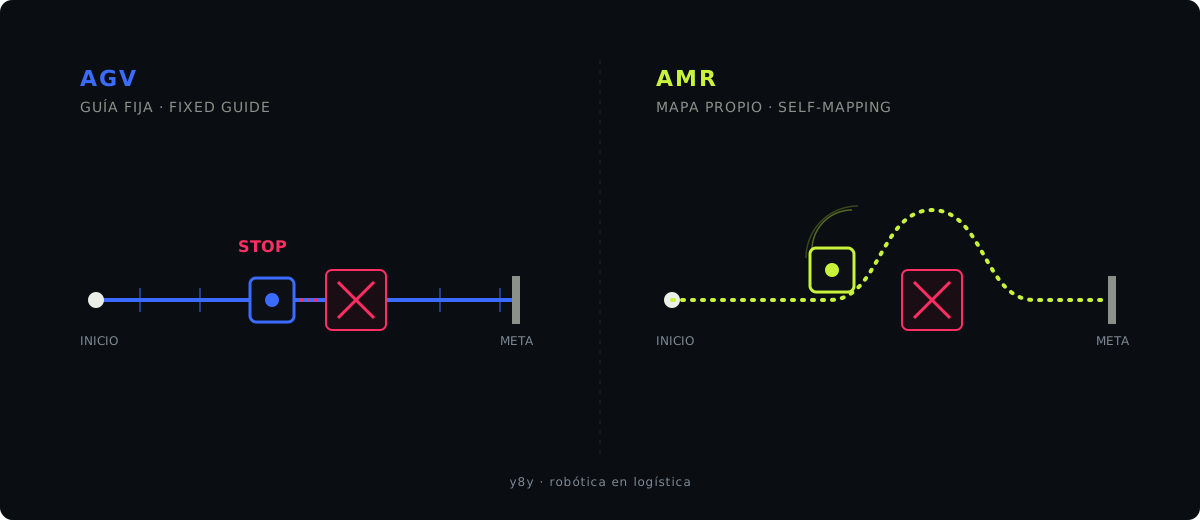
An AGV (automated guided vehicle) follows a path you have physically marked. The variants matter when you budget: inductive wire buried in the floor (the most robust and the most expensive to install), magnetic tape stuck on top (cheaper, wears out under traffic), laser reflectors on columns, or a grid of QR codes on the floor, the system Kiva made famous. In every case the intelligence lives in the installation, not the vehicle: the AGV doesn’t know where it is off its guide, and if something blocks the path, it brakes and waits for someone to move it.
An AMR (autonomous mobile robot) flips the equation: the intelligence rides on board. With laser scanners and often cameras it runs SLAM (simultaneous localization and mapping): it builds a plan of the building, locates itself in it to the centimeter and recomputes its route several times a second. A fallen pallet doesn’t stop it: it drives around. A blocked aisle doesn’t strand it: it picks another. The warehouse doesn’t adapt to the robot; the robot adapts to the warehouse.
Everything else you’ll read in this debate (cost, installation, flexibility, safety) follows from that single design decision. This table sums it up in full:
| Dimension | AGV | AMR |
|---|---|---|
| Navigation | Physical guide: wire, magnetic tape, reflectors or QR | Laser/visual SLAM: its own map, guide-free |
| Facing an obstacle | Stops and waits | Recomputes and goes around |
| Cost per unit | $15,000-80,000 | $25,000-150,000 |
| Extra infrastructure | $40,000-100,000 per facility (floor guides) | Practically none (solid wifi) |
| Time to operation | Weeks (install and calibration) | Hours or days (mapped by walking) |
| Layout change | Reinstall the guides | Walk it through once |
| Safety standard | ISO 3691-4 (guided vehicles) | ANSI/RIA R15.08 (free navigation) |
| Typical payback | 6-12 months on fixed routes | 10-24 months depending on the case |
| Best for | Stable, heavy, high-volume runs | Changing warehouses, peaks, e-commerce |
Seventy years separate a wire from a brain
The AGV isn’t a new technology competing with a newer one: it’s the sector’s veteran. In 1954, Arthur 'Mac' Barrett of Barrett Electronics unveiled industrial history’s first driverless vehicle and named it the Guide-O-Matic: a towing tractor that followed the signal of a wire, first strung from the ceiling and later buried in the floor. For six decades that idea (the vehicle obeys the installation) moved car plants, print works and entire warehouses, refined with magnetic tape and laser reflectors but never changing philosophy.
The philosophy only changed when mobile robotics made laser sensors and onboard compute affordable, and SLAM left the labs. The commercial trigger is the story we tell in our Kiva chronicle: when Amazon bought the shelf-robot maker in 2012 and stopped selling them, a whole generation of engineers went out to build the alternative, and built it guide-free. The modern AMR is the child of that slammed door. Knowing the AGV has seventy years of maturity and the AMR barely more than a decade explains their characters: one is a reliable, rigid specialist; the other a flexible generalist still learning.
The full numbers, with the list-price trap
Per unit, the AGV starts ahead: $15,000-80,000 versus $25,000-150,000 for an AMR. But the AGV buys a vehicle plus a construction job: for a facility of roughly 100,000 square feet, installing and calibrating the guides adds $40,000 to $100,000. Let’s do the math no brochure does, with an illustrative fleet of ten mid-range units: ten AGVs at $40,000 is $400,000, plus $70,000 of guides: $470,000. Ten AMRs at $60,000: $600,000, no construction. The AGV still wins on signing day.
The game is decided afterwards. If your routes won’t change for five years, the AGV pays back in 6-12 months and keeps its head start: it’s the right buy. But every warehouse reorganization costs the AGV a partial guide reinstall (tens of thousands) plus days of downtime; it costs the AMR a mapping walk. With just one layout change a year, the AMR’s premium is eaten in two or three years; with seasonal peaks that require shifting fleet between zones, sooner. That’s why the only comparable figure is total cost per year: unit, infrastructure, changes and downtime. List price is the small part.
Then there’s the cost almost nobody budgets in either case: the network. An AMR fleet needs solid industrial wifi across the whole building ($30,000-150,000 if it must be reinforced), and a modern AGV also wants connectivity for its traffic manager. That number lands on another vendor’s invoice, but it lands.
Even the safety standards know they’re different
There’s an elegant proof that AGVs and AMRs are different species: regulators needed separate standards. ISO 3691-4, the international standard for 'driverless industrial trucks', grew out of the AGV world and reasons like it: it assumes the vehicle runs on defined paths and anchors the safety requirements to those known routes. That works because an AGV’s braking zone is always the same: its path never changes.
The AMR broke that logic, and North America wrote ANSI/RIA R15.08 from the opposite premise: an industrial mobile robot that navigates with no reference to any guide. Its key contribution is dynamic: the robot must adjust its safety zones and speed on the move, according to where it decides to go and what it detects. In practice both live with certified laser scanners and emergency stops, but the question for your vendor is concrete and very telling: which standard is this vehicle assessed against, and does its safety case assume a fixed route or free navigation? If they’re selling an AMR assessed only as an AGV, the answer just saved you real trouble.
Five warehouses, five answers
One: a production line feeding the same three stations for years, on three shifts. AGV, no question. The route won’t change, volume is constant and its 6-12 month payback is unbeatable. Here an AMR means paying for flexibility you’ll never use.
Two: an e-commerce warehouse with November peaks, sales and January returns. AMR. The layout and hot zones change every season; the robots redeploy with a walk, and on RaaS the fleet grows in October and shrinks in February.
Three: a leased building where the landlord allows no construction. AMR by elimination: you can’t bury wires and sometimes can’t even stick tape. The AMR doesn’t touch the building.
Four: towing heavy trailers from dock to dispatch, hundreds of times a day, same run. A tow AGV, the direct heir of the Guide-O-Matic. High weight, eternal route, zero surprises: its natural habitat.
Five: a mixed operation with a stable trunk flow and picking that changes. Both, and it isn’t a diplomatic answer: AGVs on the trunk aisle, AMRs in the living zones. Each technology on the job it was designed for is the configuration that wins most often in mature operations. To pick the specific AMR model, continue with our warehouse-AMR comparison; for the full project budget, with our guide to what automating a warehouse costs.
Frequently asked
What is the difference between an AGV and an AMR?
An AGV follows a fixed route marked on the floor (wire, magnetic tape or QR codes) and stops at any obstacle. An AMR builds its own map with SLAM, decides its route in real time and drives around obstacles. The AGV executes a path; the AMR decides its own.
Is an AMR better than an AGV?
Neither is better in the abstract. The AGV wins on fixed, heavy, high-volume routes, paying back in 6-12 months. The AMR wins when the warehouse changes, because it reconfigures with no construction. The deciding question is whether your routes will change over the next few years.
How much does an AGV cost versus an AMR?
An AGV costs $15,000-80,000 per unit plus $40,000-100,000 of guide installation per facility. An AMR costs $25,000-150,000 with no infrastructure. With a ten-unit mid-range fleet, the AGV comes out about $130,000 cheaper on day one; every layout change cuts into that lead.
Which safety standard applies to each?
ISO 3691-4 covers driverless industrial trucks and reasons over defined routes: the AGV’s natural framework. ANSI/RIA R15.08 was written for mobile robots navigating without guides and requires dynamic safety zones: the AMR’s framework. Always ask which one the vehicle you’re offered is assessed against.
Which one deploys faster?
The AMR: you map the warehouse by walking it and it’s operational in hours or days, no construction. An AGV requires installing and calibrating physical guides, which takes weeks, and every route change repeats part of that installation.
Can AMRs and AGVs work together in the same warehouse?
Yes, and it’s the configuration that wins most in mature operations: AGVs on the fixed, high-volume trunk routes and AMRs on the flexible work that changes. It just requires coordinating both from the management system so they don’t compete for the same aisles.
Can an AGV be converted into an AMR?
Generally not cost-effectively: the difference isn’t an accessory but the architecture (sensors, onboard compute and navigation software). Some makers offer hybrid vehicles that follow guides with free navigation as backup, but a classic AGV gets replaced, not upgraded.
Numbers don’t argue. Either the robot did it alone, or it didn’t.
Sources
- AMR vs AGV: Which is Better for Flexible Material Handling?
- AMR vs AGV
- AGV vs. AMR: differences, benefits and costs
- AGV vs. AMR for Warehouse Automation: What’s the Key Difference?
- Mobile Robot Safety Standards: Understanding ISO 3691-4 and ANSI/RIA R15.08
- Essential AGV and AMR Safety Standards You Must Follow for Compliance
- The history of automated guided vehicles
- Let’s remember Mac Barrett, father of the AGV